
Suzhou Arphu Launches CE-Certified Conveyor Belt Vulcanizing Press for European Mining & Port Markets
Suzhou Arphu Rolls Out New CE-Compliant Conveyor Belt Vulcanizing Press Optimized for German & EU Industrial Standards
Modular hydraulic vulcanizer delivers uniform heating, stable pressurization and full MD/LVD/EMC compliance for mining, power plant and port conveyor maintenance
SUZHOU, CHINA – June 23, 2026 – Suzhou Arphu Co., Ltd., a professional manufacturer of rubber vulcanization equipment, today unveiled its upgraded full-series conveyor belt vulcanizing press, engineered to fully meet EU machinery safety regulations and German industrial power specifications (400V 50Hz three-phase supply). The new equipment has obtained complete CE certification, enabling seamless delivery to Germany and all European member states without customs compliance barriers.
Designed for hot splicing and on-site repair of fabric, steel cord, PVC/PVG fire-resistant conveyor belts, Arphu’s vulcanizing press integrates a high-stability hydraulic pressurizing pump, precise digital temperature control cabinet and sectional lightweight aluminum crossbeam structure, solving core pain points of uneven temperature, unstable pressure and heavy weight on traditional vulcanizers widely used in mining, metallurgy, thermal power plants and seaports across Europe.
Core technical advantages aligned with European industrial requirements:
EU-standard electrical system: Supports 400V three-phase / 230V single-phase 50Hz power supply; all electrical components comply with LVD 2014/35/EU and EMC 2014/30/EU; IP65 waterproof control cabinet with industrial quick connectors for humid mine environments.
Uniform pressure hydraulic system: Matched silent electric hydraulic pump delivers adjustable working pressure up to 2.0MPa; integrated one-piece water pressure bag ensures even force distribution across the entire heating platen, eliminating weak joint zones and extending conveyor service life.
Precision constant-temperature heating platens: Built-in silicone heating elements with internal water cooling; temperature deviation controlled within ±2°C, supporting adjustable vulcanization holding time for different belt thicknesses and rubber formulas.
Modular split design: Sectional platens and detachable beams reduce single-piece weight by 40%, convenient for underground narrow mine tunnels and remote port field maintenance; all structural materials pass mechanical safety assessment under MD 2006/42/EC.
Full compliance for German customs clearance: Complete technical construction file (TCF), EU Declaration of Conformity (DoC), German-language operation manual and permanent metal nameplate with standard CE marking (minimum 5mm height) are provided with each unit. Built-in safety components including pressure relief valves carry independent CE documentation for market supervision inspections.
“European clients, especially German mining and port operators, have strict demands on machinery safety, electrical compatibility and after-sales traceability,” said Mr. Leo Wang, Technical Director of Suzhou Arphu. “We restructured our vulcanizer’s hydraulic, electrical and mechanical safety modules strictly following VDE and EN ISO 12100 standards. The matched pressurized electric pump is integrated as a built-in component of the whole machine, so separate CE marking on the pump body is not required—our full-set CE certification covers all integrated parts, greatly simplifying customer customs declaration and on-site audit procedures in Germany.”
Compared with conventional vulcanizing equipment, the new Arphu model cuts vulcanization cycle time by 18% while lowering energy consumption, reducing downtime for conveyor production lines. Customizable sizes cover belt widths from 600mm to 2200mm, with portable spot repair vulcanizers and large integral vulcanizing presses available for different working scenarios. All finished machines undergo 72-hour continuous aging testing before shipment to guarantee stable long-term operation under harsh European working conditions.
The full series CE-certified conveyor belt vulcanizing press is now available for global order. Suzhou Arphu provides door-to-door delivery, on-site installation guidance and multi-language technical support for distributors and end users throughout Germany, France, Poland and other EU regions.
About Suzhou Arphu Co., Ltd.
Headquartered in Suzhou, Jiangsu Province, Suzhou Arphu specializes in R&D, manufacturing and export of rubber vulcanization machinery, including conveyor belt vulcanizing presses, rubber plate vulcanizers and auxiliary hydraulic power units. The company holds ISO 9001 quality management certification and full CE compliance for all export machinery. Focused on the European, Southeast Asian and Middle Eastern rubber industry markets, Arphu delivers customized industrial equipment tailored to local power, safety and environmental standards, serving mining, port, power and rubber manufacturing enterprises worldwide.
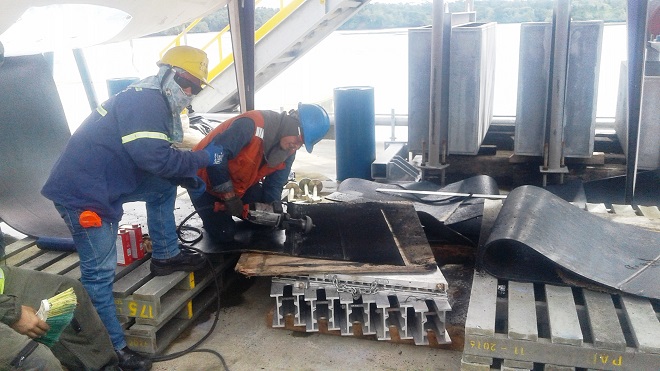
How to maintenance and repair conveyor belt
How to maintenance and repair conveyor belt
Industrial conveyor belt in every industry, from distribution centers to facilities and plants, undergo rigorous working conditions. Maintenance and engineering managers know even the best-designed conveyor belts require repairs and maintenance, which is why knowing how to efficiently repair belts and prevent future damage is very important.
How to maintenance and repair conveyor belt?
Frankly speaking, there are three ways to maintenance and repair conveyor belt:
1. The first way: hot splicing by conveyor belt vulcanizers, it’s also called Vulcanizing presses;
2. The second way: cold connection by glue;
3. The last way: repair by mechanical chain.
For this FAQ, we mainly discuss about the hot splicing belt by conveyor belt vulcanizer. The ideal effective for
repairing or splicing conveyor belt will obey the principle of same tension strength and same service life
comparing with new original conveyor belt, and only adopts hot splicing advanced technology.
The main purpose for cold splice and mechanical method is to save operation time and lessen the loss. So it’s not
the best way to choose cold splice and mechanical splice to replace hot conveyor belt vulcanizer.
The advantages for hot splice of conveyor belt by conveyor belt vulcanizers are almost same service life and same
tension strength comparing with new and original conveyor belt. Conveyor Belt Vulcanizer or Conveyor Belt
Vulcanizing Press is the best way to repair and splice belt.
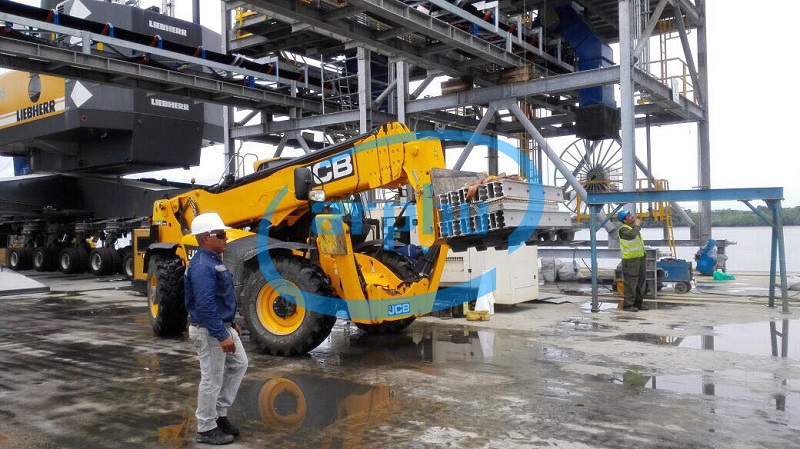
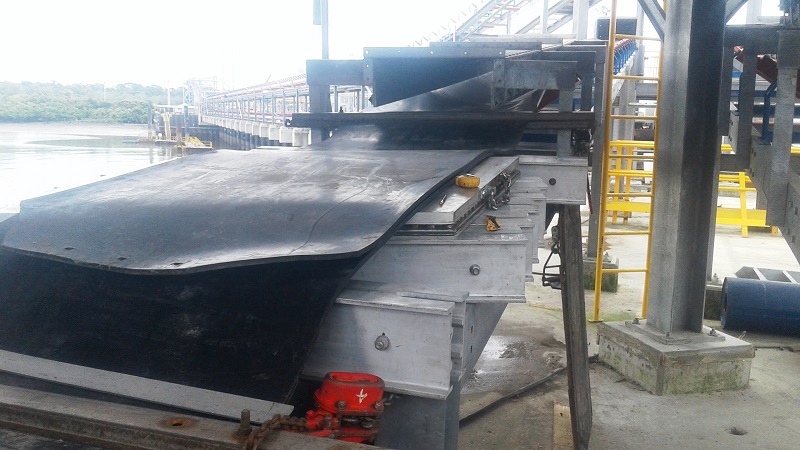
Conveyor Belt Vulcanizing Presses works at Buenaventura Port
Suzhou Arphu exported Conveyor Belt Vulcanizing Presses to our Colombian customers, and our customers feedback to us that our Conveyor Belt Vulcanizing Presses works at Buenaventura Port recently and share some pictures and videos with us.
Buenaventura port is the biggest sea port of Colombia, and also it’s the most important city around Pacific Ocean of Colombia.
Here we thank you for your always support and share with us the pictures and feedback to us that the good quality of our presses, best wishes for your prosperous businesses!
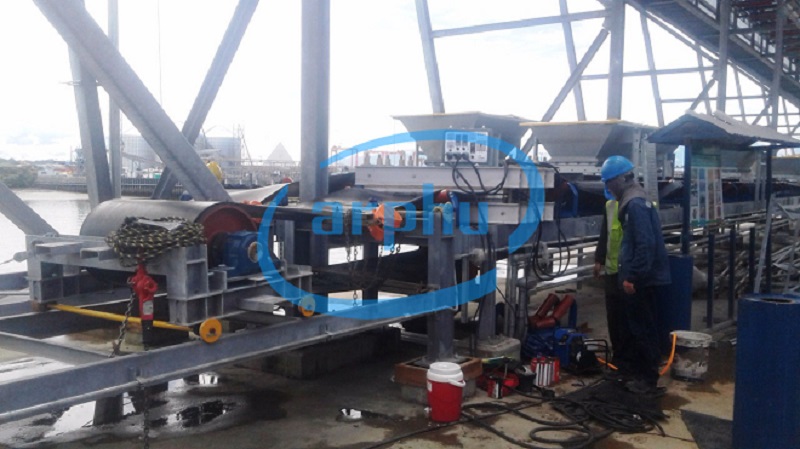
Analysis and Treatment of Conveyor Belt Vulcanizer for Common Questions
Conveyor belt vulcanizer (also called conveyor belt vulcanizing press), as for splicing tools for conveyor belt, in the process of using it may have some small problems, mostly due to improper operation, storage or maintenance.
FAQ 01: If heating up time is too long or can’t reach 145℃:
(1) If install heat insulation plate between cross beams and heating plates, if not, please install it and re-test it.
(2) If temperature can’t reach set temperature, please check if switch of “vulcanizing time” open or not, if opened, belt vulcanizer is in heat preservation stage, and temperature can’t rise. Then please close the switch.
(3) If doesn’t work after test the first two steps, please check if the heat insulation plates are moist, if yes, please drying them by heating plates.
(4) If it doesn’t work after the first three steps, please contact after sale service.
FAQ 02: If temperature non-uniformity lead to bad splicing:
(1) Check if heat insulation plates damaged;
(2)If heat insulation plates work well, please heat up heating plates separately and test heating plates surface by thermometric indicator. If temperature is non-uniformity, maybe heat resistance is damaged.
FAQ 03: If pressure can’t reach to set value by pump:
(1) If inlet of water plate is blocked by too tighten of bolts and nuts, if yes, please loosen bolts and nuts;
(2)If leakage of water or air and tighten relevant bolts, and check seals of pump.
FAQ 04: If adhesive between belt and heating plates
Please check if use heat-resistant paper between conveyor belt and heating plates.
FAQ 05: Leakage of water plate
(1)Check the leakage point, if leakage from edges of water plate, please tighten bolts;
(2)If leakage from water plate surface or avulsion, please change belt of water plate.,
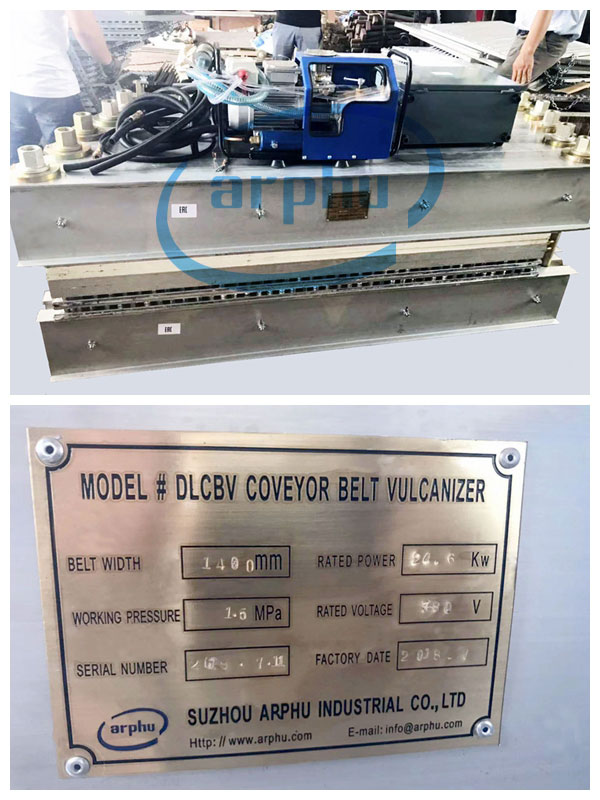
Russia Customer Purchased Conveyor Belt Vulcanizer
Suzhou Arphu exported water cooling system conveyor belt vulcanizer to our Russia customer with model DLCBV- 1400*1000. We arranged the surveyor who was appointed by customer to test vulcanizer in our factory, and all testing items met the customer’s requirements.
After the customer received test report, she thanked us our serious working attitude and professional service, then inquired model of DLCBV-800*1000 conveyor belt vulcanizer.
Thanks for your trust and support!
Repeat order for conveyor belt vulcanizer from our philippines customer
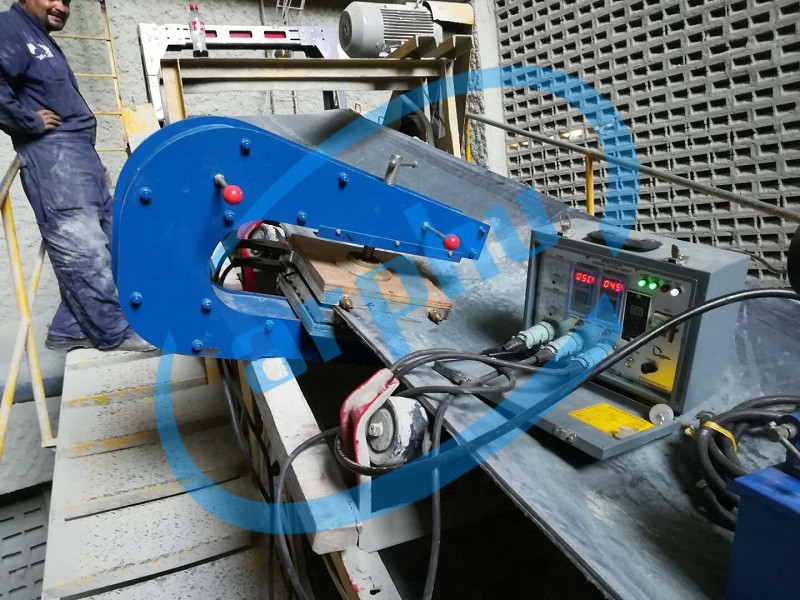
First of all, we thank you very much for this Philippines customer who purchases spot repair vulcanizer every year. This year, the customer also purchased conveyor belt vulcanizer. According to her requirements, we made a drawing for heating plate to confirm with her and produced it model of DLCBV-1200*752.
The customer received vulcanizer and spliced with it well, then she give us repeat order and feedback us that the conveyor belt vulcanizer is good quality!
Thank you very much for your support!
Safety Precautions as Operation of Conveyor Belt Vulcanizer
Safety Precautions as Operation of Conveyor Belt Vulcanizer
Conveyor belt vulcanizer belongs to industrial electroheating equipment, safety precautions are needed in the process of operation of vulcanizing presses.
1.Please prepare 2 sets of 7 kgs powder fire extinguishers, sand and water., etc;
2.All the electrical equipment must have reliable ground protection, check all the cables;
3.Keep gasoline, rubber sheet, etc far away the fire seat, and guards in position.
4.In the process of operation of conveyor belt vulcanizer, workers must guard in position, after vulcanization finished, cut off the power and clear working site, disassemble conveyor belt vulcanizer, repairing tools and splicing tools to ensure store conveyor belt vulcanizer or vulcanizing presses in dry and cool environment.